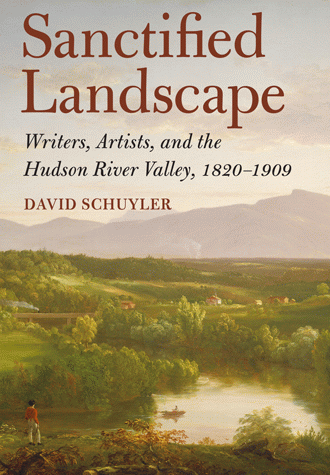
 Sanctified Landscape: Writers, Artists, and the
Hudson River Valley, 1820-1909
Sanctified Landscape: Writers, Artists, and the
Hudson River Valley, 1820-1909David Schuyler
Cornell University Press. 240 pages
$29.95
Published May 15, 2012
Sanctified Landscape: Writers, Artists, and the
Hudson River Valley, 1820-1909
David Schuyler
Cornell University Press.
240 pages
$29.95
Published May 15, 2012
Poets and painters of the early United States were determined to make a new style—an American style to show the young country’s equality with, or even its superiority to, the decadent European empires. Their subject and inspiration was what Europe did not have: untouched wilderness. According to these artists, the only people in North America had been the Indians who lived for time untold in idyllic Arcadian harmony with nature. This is a fiction, but myths are an indulgence for which every country must be forgiven; the humble Indians living in perfect communion with nature are not much more realistic than England’s Robin Hood and Maid Marion. But early America’s self-image was based in part on a previously unpeopled country. America was what happened when human beings were given a clean start. Free of history’s chains and weights, democracy, prosperity, and equality would burst forth from the wilderness as naturally as the trees and springs. Before the Mississippi, the Hudson was the national waterway; before the Rockies, the Catskill mountains were the national landscape. The Hudson Valley itself was the American wilderness, sanctified both by its beauty and as the site of much of the country’s struggle for independence. Best of all, it was conveniently close to New York City.
This combination of beauty, history, and accessibility turned the Hudson River Valley into a retreat for artists and writers of the first half of the nineteenth century. Popular writers Washington Irving and Nathaniel Parker Willis, painter Thomas Cole, and landscaper Andrew Jackson Downing, among many others, lived in the Hudson Valley and took from it the inspiration they would transmit to the rest of the early United States. Their vision of the Hudson and the Catskills would shape the American national character to the start of the twentieth century.
This is the assertion behind David Schuyler’s Sanctified Landscape: Writers, Artists, and the Hudson River Valley, 1820-1909. It is an case he makes with many small points rather than one overreaching argument. His chapters are arranged by theme, the focus of each chapter being one or two of the major figures in a movement or period, so that the book is less a single story than it is a collection of related essays. Nor does he attempt a strictly chronological presentation.
Schuyler begins the book with a chapter on early tourism in the Hudson Valley, which is an opportunity to explore the spreading fame of the area's beauty. He then follows with a few of the personalities who made the region famous. “The Painter’s River” is about Thomas Cole, the first and best-known of the Hudson River school. Schuyler takes the opportunity to examine Cole’s series of five paintings on the stages of empire as a reflection of his thoughts on civilization and nature. The chapter “The Writer’s River” concentrates on Washington Irving and his near-contemporary Willis, whose popularity has not survived as Irving’s has. Irving especially is considered as the first “American” author whose work influenced the public view of the Hudson Valley. As he wrote so much about the Dutch of the Hudson Valley, he was also able to create a reassuringly non-English history for the early New York colony.
The chapter “A River Through A Garden” explains the aesthetic philosophy of landscaper Andrew Jackson Downing. In his books Downing divided landscaping into two types: ancient, which was symmetrical, mannered, and reeked of the ancien régime of Europe; and modern, which was nature shaped — but not ruined — by the human touch. Downing further divided the modern style into the graceful, made up of curving, “feminine” lines, and the picturesque, which was masculine, Romantic, and craggy. In the prints illustrating these two modern styles it is evident that the graceful and the picturesque styles were particularly suited to, respectively, the feminine gentle hills above the Hudson River and the masculine wooded glens of the Catskills.
Schuyler also dwells on the Downing’s importance in popularizing the porch or veranda, an American contribution to domestic architecture. The veranda was considered a room of the house and was used as such by the family when the weather permitted. It extended domestic comfort into the outdoors to the point where the visible scenery was considered part of the home’s decoration.
After the 1850s the Hudson Valley began to diminish in importance. After studying the role of the Hudson Valley in "Change and the Search for Continuity at Midcentury" Schuyler spends the second half of the book exploring this decline. One of the only reasons he gives for the decline is the Civil War’s severe blow to the ideal of America as an untroubled country. The reader can also see that Manifest Destiny was a more aggressive form of the attitude that the United States was natural and right, turning attention away from the eastern part of the country to the open spaces of the west where Americans could again believe that they were starting over in untouched territory. Industry, too, took its toll. In the 1850s the previously unfettered wilderness was constrained by the railway on both sides of the river—Irving was famously upset by the disturbance of trains running past Sunnyside at midnight. By 1900 the Hudson was the dumping ground for the industrial towns that had replaced the agricultural communities along the river’s banks. And the Hudson Valley was simply too settled to be a wilderness any longer. Finally, the Romantic era had come to an end; the public interest in science turned from the natural sciences to technology. The chapter “An Elegy for the Hudson River School” concentrates on the end of painter Jervis McEntee’s career as his reserved, precise painting style was overturned in favor of the Barbizon school. “The Naturalist’s River” explores the work and life of naturalist John Burroughs as a founder of the preservation movement of the early twentieth century.
Schuyler finishes the book with a description of the 1909 Hudson-Fulton Celebration, held to celebrate Henry Hudson’s voyage up the Hudson River three hundred years earlier, as well as the hundred-year anniversary of Robert Fulton producing the first commercially successful steamship. Those who were disappointed by the lackluster Quadricentennial celebration of 2009 might take comfort in learning that the Hudson-Fulton celebration was a spectacular affair. The effects, however, were short-lived. The replica of Fulton’s Clermont was eventually disassembled and Hudson’s Half Moon burned after being dragged to a park in Cohoes. Some planned memorials were completed late or not at all. To those who feel a connection to the Hudson Valley it is a particularly sad ending—the last hurrah of a region that didn’t realize its time was already past.
Apart from the theme of the Hudson River Valley during its period of national importance, there is little to link the sections of the book together. The chapters do not tie into or build upon one another, and they are of varying quality. Schuyler is more interested in the personalities than in historic movements or great events. He expects the lives and careers of his subjects to show the effect of their work on the larger American consciousness, but the result is not always enlightening. In “A Writer’s Paradise” he dedicates more space to Irving’s development of his home Sunnyside than to Irving’s writing and its effect on the larger American consciousness. Willis’s work is described in four pages (perhaps as a favor to readers who cannot be expected to be familiar with it) whileIdlewild, his home, has one and a half pages of text and a half-page illustration. “An Elegy for the Hudson River School” is only somewhat successful at showing the shrinking interest in realistic portrayals of nature. It concentrates too much on McEntee’s misfortune and does not explore the changing interests of the public. Schuyler seems to be guided by his own areas of interest, and those interests do not always mesh well into a cohesive whole.
The weak sections, however, do not drag down the strong ones. Some of the chapters stand well on their own. “A River through a Garden” offers a fascinating look at the large-scale transformation of the Hudson Valley. Schuyler has a continuing interest in the landscaping and architecture of those who shaped the Hudson River Valley and in writing about Downing the reader feels this interest most keenly. A familiarity with sites such as Montgomery Placeor Locust Grove makes the chapter more enjoyable. Schuyler vividly describes Downing’s landscaping of the approach to Montgomery Place with hills, trees, and a curving drive that dramatically revealed the house as the guests neared it. It is another form of Schuyler’s theme of landscape as spectacle.
Also enjoyable is the chapter on the pre-Civil War interest in early United States history. The Hudson Valley was changing in its agricultural pursuits, in its embrace of commerce and industry, and even, as German and Irish immigrants moved in with the descendants of New York's first settlers, in its cultural and social makeup. Schuyler takes the opportunity to explore the growing movement towards historic preservation. He focuses on the Hasbrouck House in Newburgh, which is still preserved today as Washington’s Headquarters during the last year of the Revolution.
A quietly successful chapter is “The Naturalist’s River”, which gracefully combines Burroughs’ writing, his love of nature, his homes (including Slabsides), and his influence on the preservation efforts of such people as John Muir, Theodore Roosevelt, and Henry Ford. Burroughs’ opinion of the Hudson Valley is presented as the most sophisticated and personal in the book as it changes from admiration to a feeling of slight alienation. He loves the region, but having grown up on the western side of the Catskills, he cannot feel a connection to the river itself. He is also the person described in the book as most willing to let nature be itself. He insisted on observation and exact description and castigated those who took liberties with the facts or anthropomorphized the natural world.
Burrough's attitude is singular. For much of the book Schuyler presents the Hudson River as a sort of Rorschach test. In its wilderness, people saw what they wanted to see. The interpretation of wilderness was paramount, giving the impression that the landscape would not fully exist without someone to interpret it, or at least view it. In some cases this creation is literal. Much of the current landscape of the Hudson Valley would not have existed without human interference. Downing is the most obvious example as his shaping the views of the scenery from his clients’ estates on the banks of the river also shaped the scenery itself, creating the gardens and green stretches of lawn visible from the Hudson. Even more appropriate is Schuyler’s description of Irving’s vision for Sunnyside being built around, and gradually covering up, the unassuming two-room Dutch house that was its original form.
The natural beauty and the beautiful naturalness of the landscape also became a marketable commodity. "The Tourists' River" chapter, is very interesting as it describes this phenomenon. Mountain lodges were strategically placed to take advantage of grand views, hotels built, sightseeing trips arranged, and the operator of the sawmill at the Kaaterskill Falls paid to raise the floodgate and return the waterfall to its previous glory. The scenery was one of the many pleasures that the elite enjoyed on their trips through the region.
The best chapters also provide the most insight into the period’s understanding of beauty. Today we have a vague understanding that it is good to enjoy nature, that according to the “Broken Windows” theory a well-maintained environment is preferable to an unpleasant one, that trees are beautiful while prefabricated houses are not especially so, and that seaside hotel rooms are likely to cost more than the rooms facing the land. But the first half of the nineteenth century retained the sense of beauty as morally and spiritually good. The rhetoric of the Romantic writers might lapse into purple prose, but it is sincere in its descriptions of the Catskills and Hudson Valley as sublime. "Few prospects can be imagined more romantic, more stirring or more beautiful...," James Silk Buckingham reported (13); Timothy Dwight described "...a wild and awful sublimity..." (15); Willis described the view from West Point as one of "...few . . fairy spots in this working-day world." (61) Burroughs considered nature to be a palliative to the industrialized world, saying, “We live in an age of iron and have all we can do to keep the iron from entering our souls.” (147) The scenery existed to be looked at and interpreted, but it also acted on the passive viewer. To experience nature was to allow yourself to be changed by it.
Over time this attitude declines in intensity. With its vague and sentimental platitudes and its struggle against industrialization it was bound to be defeated. As early as the 1840s Downing is content to argue more modestly that a pleasant home led to a happy domestic life, which in turn resulted in good moral character. This he believed so thoroughly that he published a book of affordable house and landscape designs. Upon hearing that these designs were too expensive for laborers to put into practice, Downing produced plans for houses and grounds that could be created for as little as two hundred dollars.
In fact, many of the figures in the book attempted to bring the nature to the public in some form or another. It was a natural result of their interpretation and of their vocations as artists, poets, novelists, and landscapers, and for most it was a means of preserving nature from the same public they attempted to reach. Cole’s sweeping landscape paintings were of great interest to the public, but he also worked to teach the American public to appreciate the country’s scenery in the hope that this would preserve the natural world from human depredation. Upon meeting Theodore Roosevelt, Burroughs was surprised to learn that Roosevelt had given copies of Burroughs’ booksWake-Robin and Winter's Sunshine to disadvantaged city boys in the hopes of creating in them a love of nature. In "The Tourist's River" Schuyler quotes the James Fenimore Cooper hero Natty Bumppo’s plea that humans not destroy nature’s beauty and bounty; while this plea is part of the novel, it was also a plea directly to the novel’s reader. If they could not use their own love of nature as an argument to preserve it, then writers and artists were able to argue that this wilderness was what made America unique.
To what extent did early Americans successfully use the Hudson Valley to define itself as culturally distinct from Europe- The book leaves this to the reader to answer. American painters were certainly able to define themselves—although they used European techniques, they represented American philosophies and landscapes. In literature Americans were also successful as Irving published immensely popular historical fiction. The book refers occasionally to Cooper, another popular and influential author of American historical fiction, who before his move to Lake Otsego in the 1830s lived briefly in Westchester County.
Architecturally, America seemed to have more difficulty separating from European forms. Downing’s explanation of how to adapt an existing property to a modern style includes “before” and “after” illustrations that are reproduced in the book. Interestingly, the “before” picture is much more American to our modern eyes than the “after” picture. The latter is a simple house with a straight drive and a fence, all of which suggest rectangular agricultural fields and livestock pens, while the former has a curving drive, ornamental trees, no fences, and a house with trim, a decorative gable, and a veranda. The styles adopted by Downing, his partner Calvert Vaux, and other architects of the time took their inspiration from Swiss chalets, Italian villas, gothic revival castles, and, at Sunnyside, a vaguely Spanish-styled addition called the pagoda. America’s first consciously created architectural style, it seemed, was still drawn from European models.
But in other ways the young United States was still judging itself by Europe’s standards. The Hudson River was described as the Rhine of the west in its beauty and the Catskills were comparable to Switzerland, which throughout the nineteenth century was a vacation spot for artists, writers, and society. It was not until the United States grew westward that it developed a completely independent American identity. The artists were right that the United States’ uniqueness lay in its landscape; but that landscape was not the one they were familiar with.
Schuyler has put care into making the book accessible. Readers will come away enriched but not overwhelmed. The individual chapters are self-contained enough that one can read them separately or out of order without hurting the quality of the book, and they are a comfortable length for undergraduate students. While scholars can appreciate Schuyler’s research and interpretations, the book is really meant for the casual reader who might otherwise know little about the subject. Many of Schuyler’s subjects are enhanced by the information he imparts. Having read the aforementioned description of the approach to Montgomery Place, for example, one cannot experience it without remembering that it represents a uniquely regional phenomenon, the result not of chance and nature but of an aesthetic plan peculiar to that time and place. The book has the ability to make its readers see with new understanding.
The book will be of special interest to those who live in or are connected to the Hudson Valley. They probably do not know that the region had such an effect on a young United States, nor that it was both interpreted and formed through such a lofty philosophy. To those with a connection to the Hudson Valley the book is a bit sad. It is their history, but it details a time of glory that the region will probably never experience again. “Is that what we once had-” the book may lead them to say. “Is there nothing more-” Or, perhaps better, “This is our past; how will we include it in our future-”
Anne Matusiewicz, MA
© New York History Net 1996-2014