|
|
Noteworthy
recent books
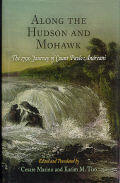
Along
the Hudson and Mohawk: The 1790 Journey
of Count Paolo Andreani
Cesare Marino and Karim M. Tiro, Editors
and Translators
University of Pennsylvania Press
In the summer of 1790 the Italian
explorer Count Paolo Andreani embarked
on a journey that would take him through
New York State and eastern Iroquoia.
Traveling along the Hudson and Mohawk
Rivers, Andreani kept a meticulous
record of his observations and
experiences in the New World. Published
complete for the first time in English,
the diary is of major importance to
those interested in life after the
American Revolution, political affairs
in the New Republic, and Native American
peoples.
Through Andreani's writings, we
glimpse a world in cultural, economic,
and political transition. An active
participant in Enlightenment science,
Andreani provides detailed observations
of the landscape and natural history of
his route. He also documents the manners
and customs of the Iroquois, Shakers,
and German, Dutch, and Anglo New
Yorkers. Andreani was particularly
interested in the Oneida and Onondaga
Indians he visited, and his description
of an Oneida lacrosse match accompanies
the earliest known depiction of a
lacrosse stick. Andreani's American
letters, included here, relate his
sometimes difficult but always revealing
personal relationships with Washington,
Jefferson, and Adams.
Prefaced by an illuminating
historical and biographical
introduction, Along the Hudson and
Mohawk is a fascinating look at the New
Republic as seen through the eyes of an
observant and curious explorer.
Cesare Marino is an anthropologist
with the Smithsonian Institution. His
books include The Sioux Vocabulary of
1823, Dal Piave at Little Bighorn, and
The Remarkable Carlo Gentile, Pioneer
Italian Photographer of the West. Karim
M. Tiro teaches history at Xavier
University.
(from UPenn Press' description)
|
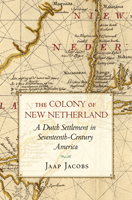
The
Colony of New Netherland: A
Dutch Settlement in
Seventeenth-Century America
Jaap JacobsThe Dutch
involvement in North America
started after Henry Hudson,
sailing under a Dutch flag in
1609, traveled up the river that
would later bear his name. The
Dutch control of the region was
short-lived, but had profound
effects on the Hudson Valley
region. In The Colony of New
Netherland, Jaap Jacobs offers a
comprehensive history of the
Dutch colony on the Hudson from
the first trading voyages in the
1610s to 1674, when the Dutch
ceded the colony to the English.
As Jacobs shows, New
Netherland offers a distinctive
example of economic colonization
and in its social and religious
profile represents a noteworthy
divergence from the English
colonization in North America.
Centered around New Amsterdam on
the island of Manhattan, the
colony extended north to
present-day Schenectady, New
York, east to central
Connecticut, and south to the
border shared by Delaware, New
Jersey, and Pennsylvania,
leaving an indelible imprint on
the culture, political
geography, and language of the
early modern mid-Atlantic
region. Dutch colonists' vivid
accounts of the land and people
of the area shaped European
perceptions of this bountiful
land; their own activities had a
lasting effect on land use and
the flora and fauna of New York
State, in particular, as well as
on relations with the Native
people with whom they traded.
Sure to become readers' first
reference to this crucial phase
of American early colonial
history, The Colony of New
Netherland is a multifaceted and
detailed depiction of life in
the colony, from exploration and
settlement through governance,
trade, and agriculture. Jacobs
gives a keen sense of the built
environment and social relations
of the Dutch colonists and
closely examines the influence
of the church and the social
system adapted from that of the
Dutch Republic. Although Jacobs
focuses his narrative on the
realities of quotidian existence
in the colony, he considers that
way of life in the broader
context of the Dutch Atlantic
and in comparison to other
European settlements in North
America.
(From Cornell University Press) |
|
|
The second digital edition of the
Papers of Sir William Johnson is now available
on CD from the New York
State Library for $20.
The CD has over 16,000 pages in 20
hyperlinked volumes. Every word is
searchable and documents may be accessed in
chronological order. Illustrations newly
scanned from Manuscripts and Special
Collections.
To purchase a copy,
contact Aimee Pelton in Documents and
Digital Collections via phone at (518)
474-7492 or email at
apelton@mail.nysed.gov. |

|
|
|
|
What is now New York State
was a frontier between two world
empires battling for supremacy
in North America.
The French claimed and occupied
all the waterways flowing into
the St. Lawrence River,
including Lakes George and
Champlain as well as all of the
Great Lakes, building forts at Niagara,
Crown
Point, Ticonderoga,
and other places. The British
empire expanding from the
Hudson-Mohawk watershed built Fort
William Henry on Lake George
and Fort
Oswego on Lake Ontario which
challenged the French
claims.
The
New
York State French and Indian War
250th Anniversary Commemoration
Commission was established
to raise awareness of this
significant and fascinating
period of world history.
|
|
The
Department of State for New York
State maintains a
Kid's Room site that answers
such questions as "what
is the state bird of New York?"
and "What
does Chautauqua mean?", as
well as
short essay on the history
of New York State, among other
things. A must for students
doing projects on New York and
worth a visit by anyone. |
|
|
Drums
Along the Mohawk is Greg
Ketcham's research on the
Revolutionary War in the Mohawk
Valley. A true labor of love.
Now hosted by New York History
Net. |
|
|
Conferences &
Meetings
The Conference on New York State History
June 3–5, 2010
Ithaca College
2009
Program
2008
Program
2007
Program
2006
Program
2005
Program
2004
Program
2003 Program
2002 Program |